Truman Capote: Knowing and Going

Updated: Jun 19
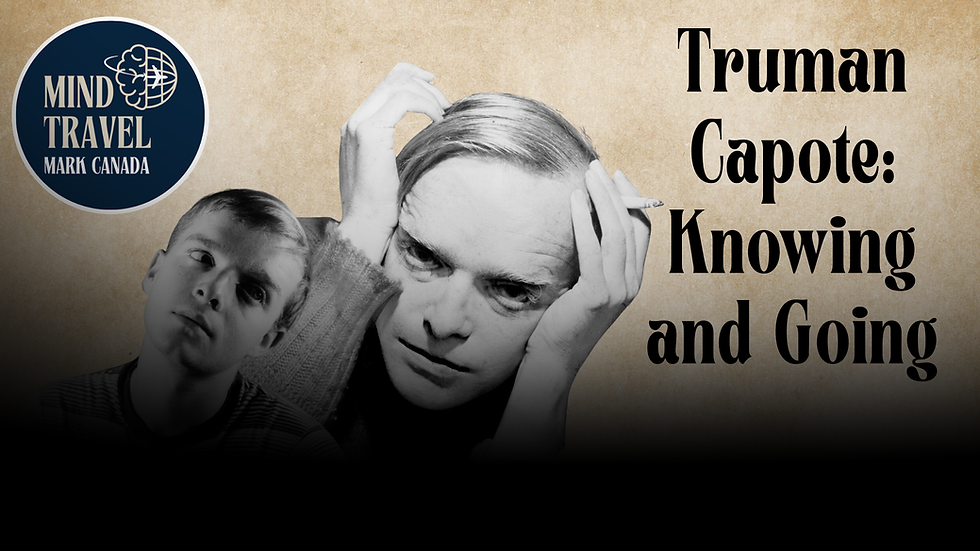
If you have spent a lot of time in the world of books (as I have) and especially if you have been a writer yourself (as I am), then you probably know this little piece of advice for writers: write what you know. It’s sound advice, if sometimes hard to take.
For some reason, writers, especially when writing fiction, can be lured by the siren call of the new, the strange, the exotic. People, places, and experiences that are unfamiliar to us are naturally interesting simply because they are different from what we know.
The problem with writing what you don’t know is that you might not get it right. Indeed, you probably won’t get it right. How could you? You don’t know all the nuances, and you may be tempted to fill in the details with your imagination. This is especially problematic when those details come out of your own sense of what you think they should be (or what you want them to be) instead of what they really are.
While the best writers write what they know, some also write where they go. That certainly was the case for Truman Capote, but he had a useful method for going and knowing, something that can make some of us better writers and all of us better people.
Living and Knowing in Worlds Apart
Truman Capote – or Truman Persons, as he was originally named – was born in New Orleans, but his life – one of the most interesting literary lives I have studied – included a fair share of going and knowing. He lived, at one time or another, in a small town in Alabama and, on the other end of the spectrum, in New York City.
Truman’s childhood in Monroeville, Alabama, was immortalized in a book by another writer. In fact, there’s a good chance you have read this book, but didn’t realize you were reading about a boy who would become one of the most celebrated writers of the late twentieth century. The book is called To Kill a Mockingbird, and it was written by Harper Lee, who also lived in Monroeville. Truman was the inspiration for Dill, Scout’s friend in the novel.
Like Dill, Truman was living with extended family in Monroeville. His mother and father, Lillie Mae and Arch Persons, were still married, but were largely estranged, and, for years, neither apparently was all that interested in raising their son, not enough anyway to live in Monroeville with him or take him somewhere else. As a young boy in the late 1920s and early 1930s, he saw them only occasionally.
Finally, when he was about 8 years old, his mother took him to live with her and her new husband, Joe Capote, in New York City. Despite his indifference to formal schooling (he had to repeat his senior year at The Franklin School), Truman eventually thrived as a young writer in New York, the heart of publishing in the United States. He befriended a number of men and especially women in elite social and professional circles: heiress Gloria Vanderbilt, novelist Carson McCullers, Oona O’Neill (daughter of playwright Eugene O’Neill), Babe Paley (wife of CBS magnate Bill Paley), Harper’s Bazaar editor George Davis, and others.
As a writer, Capote was now in an interesting position. If he was going to write what he knew, he could revisit his childhood in small-town Alabama (as his friend Harper Lee would eventually do), or he could draw from his life as a young adult in the big city.
He did both.
Some of his early fiction is set in the South, which he knew well as his childhood home, but he also wrote a novella firmly anchored in New York: Breakfast at Tiffany’s (which would achieve a new level of fame when it was adapted into a film starring Audrey Hepburn). In both cases, he had come to know the worlds he was describing by actually living in them.
Then came a new challenge.
A Stranger in Kansas
In 1959, four members of the prominent Clutter family in tiny Holcomb, Kansas, were murdered in their home. Capote, as he tells the story, came across a short article about the murders in The New York Times and became intrigued. The author said he had been contemplating a novel based on actual events, and this event seemed promising. (I’m using qualifiers such as “The author said” because I’m not completely convinced that Capote felt as constrained by the facts as we scholars do—or should. He reminds me a lot of Poe. As actual and de-facto orphans, they seem to have shared some personality traits.)
When Capote showed up in Kansas that same year to begin conducting research for his novel, he was venturing into new territory—literally and literarily. In works such as Breakfast at Tiffany’s, he had written what he knew from firsthand experience; he had lived in Manhattan after all. When he arrived in Kansas, Capote was a stranger in a strange land. He had never been to the state and did not know the Clutters or their neighbors. This stranger was also just plain strange, at least by rural Kansas standards.
If you know much about Capote’s visit to Kansas, it may be because of the film Capote, which came out back in 2005 and featured Philip Seymour Hoffman, but I actually prefer another biopic, Infamous, which came out a year later. In the latter, the brilliant British actor Toby Jones, who looks a lot like the young Capote, reenacts a real-life scene that provides a fascinating glimpse into Capote’s time in Kansas.
The urbane writer with a babyish voice is out of his element in Kansas—or would seem to be. Alvin Dewey, a detective investigating the Clutter murders, is not inclined toward him, but his wife Marie, an avid reader, persuades Alvin to invite the stranger to their home for dinner.
The scene, featuring Jeff Daniels as Alvin Dewey and Sandra Bullock as Harper Lee (whom Capote brought to Kansas to serve as his assistant), is comical. What are these very different people—some Kansas locals and this character from the big city—going to talk about for hours? Then Capote casually refers to the actor Jennifer Jones and “Bogie.” Alvin Dewey perks up. Does Capote actually know the actor Humphrey Bogart? Yes, he does. In fact, Capote shares, he has played poker with Bogie and even bested him in arm wrestling. Now the locals are eating out of the stranger’s hand.
A Roomful of Knowledge
This scene is a highlight of the film for me, but, more to the point, it also reveals part of Capote’s secret to combining going and knowing.
Creative writers can work anywhere and say anything they want to say. They are, after all, creative writers; they are making things up, and we’re generally OK with that. Still, if what they are writing is to have any basis in reality, they ought to know their subject intimately. The goal was especially important to Capote, who was attempting to write a “nonfiction novel” capturing actual events. Again, great writers write what they know.
How, then, can you write about something that is outside your experience? You make it part of your experience. That’s what Capote did. He immersed himself in rural Kansas, interviewing people who knew the Clutters and the community. To facilitate his interviews, he developed an impressive method, which he described in an interview with fellow writer George Plimpton:
Twelve years ago I began to train myself, for the purpose of this sort of book, to transcribe conversation without using a tape-recorder. I did it by having a friend read passages from a book, and then later I'd write them down to see how close I could come to the original. I had a natural facility for it, but after doing these exercises for a year and a half, for a couple of hours a day, I could get within 95 percent of absolute accuracy, which is as close as you need. I felt it was essential. Even note-taking artificializes the atmosphere of an interview, or a scene-in-progress; it interferes with the communication between author and subject—the latter is usually self-conscious or an untrusting wariness is induced.
By the time he was done, Capote said, he had “enough material to fill a whole room with boxes, just of material” he didn’t even use.
That’s going and knowing.
Getting Our Own Stories Right
You don’t have to be a writer to glean a useful insight from Capote’s experience. All of us, after all, tell stories, if only to ourselves. When we go somewhere, make new acquaintances, and encounter new things, we naturally construct internal versions of what we experience: stories.
How accurate are these stories? We may never know. It’s probably safe to say, though, that the accuracy depends on how thoroughly we have done our “research.” Truman Capote did not live the experiences of the Clutters, their neighbors, or the murderers, but he probably got as close as anyone could by collecting a roomful of information (or more) about his subject.
The result was not a perfect embodiment of the people, places, and events he was describing and narrating. No one can achieve that level of accuracy and comprehensibility. Besides, language is always an imperfect representation of reality. Still, it pays to do your homework.
Wherever you go—to another state or country, to a different workplace, or even just to a party or meeting—you often will encounter people and experiences new to you. How much will you know after you go? Will you tell yourself stories based on what you assumed you saw or wanted to see, or will you build your stories based on observations and conversations that take you closer to the real thing?
The answer matters, not merely to us as individuals, but also to the world we inhabit together and can improve together. The more we know, the further we can go.


Very interesting article, we'll be watching Capote